
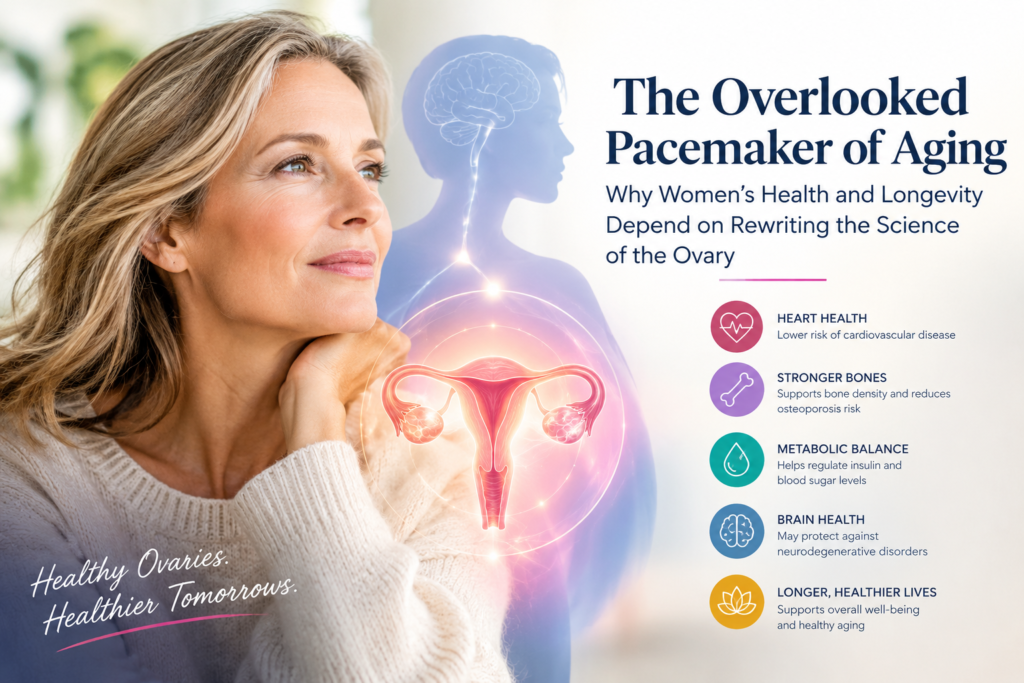
The Overlooked Pacemaker of Aging Why Women’s Health and Longevity Depend on Rewriting the Science of the Ovary
Aging is one of the most significant risk factors for chronic diseases, including cardiovascular disease, osteoporosis, diabetes, and neurodegenerative disorders. Although scientific advances have improved our understanding of longevity, an essential aspect of human aging remains insufficiently explored: the role of the female ovary. Traditionally viewed primarily as a reproductive organ, the ovary is increasingly recognized as a vital endocrine organ that influences health throughout a woman’s life. Understanding ovarian aging may therefore be crucial to improving women’s health, extending health span, and addressing long-standing inequalities in medical research.
Beyond Reproduction: The Ovary as an Endocrine Organ
For decades, ovarian research has focused largely on fertility, pregnancy, and reproductive disorders. However, the ovary performs functions that extend far beyond reproduction. It produces hormones, including estrogen, progesterone, and androgens, which influence multiple physiological systems. These hormones contribute to bone maintenance, cardiovascular function, metabolism, brain health, and the regulation of reproductive processes.
As ovarian function changes with age, hormone production and signaling also change. The transition toward menopause can affect sleep, mood, body composition, bone density, and other aspects of physical and mental well-being. Estrogen deficiency after menopause is associated with increased bone loss and changes in cardiovascular risk factors, although individual outcomes vary considerably.
Recognizing the ovary as an important component of the body’s endocrine network offers a broader perspective on women’s health. Rather than examining reproductive health in isolation, researchers can investigate how ovarian function interacts with other organs and influences health across the lifespan.
Understanding the Biology of Ovarian Aging
Ovarian aging is a complex biological process involving the gradual depletion of the ovarian follicle reserve, changes in hormone production, and alterations in the surrounding tissue environment. Unlike many other organs, which can maintain or repair certain functions throughout life, the ovary has a finite supply of follicles that declines over time.
The pace of ovarian aging varies between individuals and is influenced by genetic, environmental, and lifestyle factors. Although ovarian function may begin changing well before menopause, the timing and extent of these changes cannot be predicted accurately from chronological age alone.
Ovarian aging also has implications beyond the end of menstruation. Premature ovarian insufficiency (POI), for example, occurs when ovarian function declines before the age of 40. It can affect fertility and hormone levels and may have implications for bone and cardiovascular health. Polycystic ovary syndrome (PCOS), meanwhile, is a distinct hormonal and metabolic condition that can occur during reproductive life; it should not be considered a direct consequence of ovarian aging.
These distinctions are important. Researchers must investigate the different mechanisms underlying reproductive disorders, the menopausal transition, and age-related changes in ovarian function rather than treating them as a single process.
The Research Gap: Sex Bias in Medical Science
Historically, biomedical research has frequently relied on male cells, animal models, and study participants, leaving important questions about female physiology unanswered. Concerns about hormonal fluctuations have sometimes contributed to the underrepresentation of females in research, although policies and practices have evolved significantly in recent decades.
In 2016, the US National Institutes of Health implemented its policy requiring researchers to consider sex as a biological variable in studies involving vertebrate animals and humans. This represented an important step toward improving the relevance of biomedical discoveries for both sexes.
Nevertheless, substantial gaps remain in our understanding of ovarian biology and its relationship to long-term health. More research is needed to identify the molecular mechanisms of ovarian aging, develop reliable biomarkers, and determine how changes in ovarian function relate to diseases that emerge later in life.
Greater investment in women’s health research could help address these gaps. Funding should support basic science, longitudinal studies, clinical trials, and the development of treatments specifically designed to meet women’s health needs.
Ovarian Aging and Healthy Longevity
Healthy longevity is not simply about living longer; it is about maintaining physical, cognitive, and emotional well-being throughout life. Because ovarian hormones influence several body systems, understanding their changing effects may help researchers identify opportunities to preserve health during midlife and beyond.
For example, studies of ovarian aging could improve the early identification of women at increased risk of premature ovarian insufficiency or accelerated bone loss. Research may also clarify how hormonal changes interact with sleep, metabolic health, and cardiovascular risk.
However, ovarian aging should not be regarded as the sole driver of women’s aging. Genetics, socioeconomic circumstances, nutrition, physical activity, environmental exposures, and access to healthcare also play important roles. The relationship between ovarian function and longevity is multifaceted and requires careful scientific investigation.
Hormone therapy can be appropriate for certain menopausal symptoms and clinical circumstances, but its benefits and risks depend on individual health history, age, timing, and treatment type. It should not be presented as a proven method of reversing aging or extending lifespan.
The Economic and Social Importance of Women’s Health
Improving women’s health benefits individuals, families, communities, and economies. When women have access to timely diagnosis, effective treatment, and evidence-based preventive care, they are better positioned to maintain their independence, participate in the workforce, and enjoy a higher quality of life.
Investing in ovarian research could also stimulate innovation in diagnostics, therapeutics, and preventive medicine. Collaboration among universities, healthcare institutions, biotechnology companies, and public funding agencies will be essential to translating laboratory discoveries into meaningful clinical advances.
Equally important is public awareness. Menstruation, infertility, perimenopause, and menopause should be discussed openly and without stigma. Better education can help women recognize changes in their health, seek appropriate medical advice, and participate in informed decisions about their care.
Conclusion
The ovary deserves recognition as more than a reproductive organ. Its changing function across a woman’s life provides an important opportunity to investigate the connections between endocrine biology, aging, and long-term health. Yet, much remains unknown, and promising hypotheses must be tested through rigorous research rather than accepted as established fact.
Rewriting the science of ovarian aging requires sustained funding, inclusive research practices, multidisciplinary collaboration, and greater public engagement. By placing women’s physiology at the center of longevity research, science can move toward a more comprehensive understanding of aging and develop better strategies to support women’s health throughout life. The ultimate goal is not simply to extend lifespan, but to ensure that women can experience more years of health, independence, and well-being.
About Wellcore Weekly: Wellcore Weekly covers health, wellness, nutrition, sleep, fitness, and medical research with timely, easy-to-understand updates for everyday readers.