
Kitchen Remedy or Real Medicine? The Truth Behind the 87% ‘Onion Juice’ Hair Loss Miracle
Published: June 13, 2026
If you’ve spent more than five minutes scrolling through natural health forums or wellness TikTok lately, you’ve likely stumbled across a mind-boggling claim: a common kitchen vegetable can allegedly reverse severe, patchy hair loss with a staggering 87% success rate.
Unlike most internet wellness trends that vanish into thin air under a microscope, this one actually has peer-reviewed backing. The viral claim traces directly back to a landmark clinical trial published in The Journal of Dermatology by researchers Dr. Khalifa E. Sharquie and Dr. Hala K. Al-Obaidi.
The dermatologists tested a deceptively simple treatment—applying crude, raw onion juice (Allium cepa L.) directly to the scalp twice a day. What they discovered shook the traditional dermatological community: within just six to eight weeks, 86.9% of the participants experienced significant hair regrowth.
The results were even more lopsided when broken down by gender. Male participants witnessed an incredible 93.7% success rate, while female participants still saw a highly respectable 71.4% turnaround. Compared to the control group, who rubbed plain old tap water on their heads and saw virtually zero progress, the onion juice group achieved a legitimate statistical breakthrough.
The Biological “Distraction” Technique
To understand why this works, you have to look at the specific type of hair loss the doctors were treating. This wasn’t a study on typical male pattern baldness (androgenetic alopecia). Instead, the researchers were treating alopecia areata—a frustrating, erratic autoimmune condition where the body’s own immune system gets confused and launches a full-scale attack on its own hair follicles, causing them to shut down in patches.
┌────────────────────────────────────────────────────────┐
│             THE AUTOIMMUNE REVERSAL MECHANISM          │
├────────────────────────────────────────────────────────┤
│ 1. THE AUTOIMMUNE ATTACK:                              │
│    Immune cells mistakenly assault healthy hair        │
│    follicles, forcing them into a dormant state.       │
│                                                        │
│ 2. THE TOPICAL IRRITATION (ONION JUICE):               │
│    High sulfur and phenolic compounds create a mild,  │
│    localized inflammatory response on the scalp.       │
│                                                        │
│ 3. THE DIPLOMATIC DIVERSION:                           │
│    The immune system diverts its attention to manage    │
│    the surface irritation, leaving follicles free to    │
│    awaken and enter the growth phase.                  │
└────────────────────────────────────────────────────────┘
The science suggests that crude onion juice acts as a potent, natural topical irritant. Packed with heavy sulfur and phenolic compounds, the juice creates a mild, safe inflammation on the surface of the skin.
Dermatologists refer to the underlying concept as “antigenic competition.” Essentially, the intense surface irritation creates a tactical distraction. The body’s misdirected immune cells abandon their assault on the deep hair follicles to deal with the new irritation on the surface. Once the pressure is off, the dormant follicles are finally free to wake up, reset, and transition back into a healthy growth phase.
The Reality Check: Read the Fine Print
Before you run out to your local grocery store and buy out the produce section, a healthy dose of editorial skepticism is highly warranted here. While the 87% headline is entirely factual, the structure of the trial itself leaves plenty of room for debate:
- Small Sample Sizes: The study relied on a tiny pool of just 23 active participants in the treatment group. In the world of clinical science, drawing sweeping conclusions from two dozen people is incredibly risky.
- The Blinding Nightmare: A gold-standard clinical trial requires “blinding”—meaning neither the patient nor the doctor knows who is getting the real treatment. Given the eye-watering, highly pungent aroma of raw onions, hiding who was getting the real juice and who was getting tap water was logistically impossible. Bias is almost a guarantee here.
- The Scalp Punishment: High sulfur concentrations are fantastic for industrial applications, but on a sensitive human scalp, they can easily trigger severe contact dermatitis, intense itching, and localized burning.
Our Take: Is It Worth the Stench?
There is a very clear reason why global pharmaceutical giants haven’t packaged raw onion juice into a multi-billion-dollar prescription bottle: you simply cannot patent a backyard vegetable, meaning there is zero financial incentive for companies to fund massive, multi-million-dollar follow-up trials.
If you are dealing with patchy alopecia areata and prefer to explore accessible, non-pharmaceutical options before resorting to heavy steroid injections, this unconventional method presents a fascinating, low-cost experiment.
Just keep your expectations grounded in reality. This is an intensive, messy commitment that requires squeezing fresh juice and applying it to your head twice a day for two full months. If you have the patience—and a family or roommate willing to tolerate a home that permanently smells like a commercial kitchen—the data shows your hair follicles might just thank you for it.
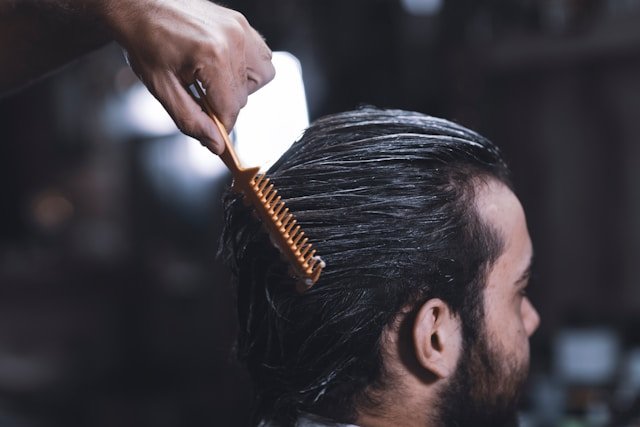
Photo by mostafa meraji on Unsplash
About Wellcore Weekly: Wellcore Weekly covers health, wellness, nutrition, sleep, fitness, and medical research with timely, easy-to-understand updates for everyday readers.