
Beyond the Textbook What the Most Detailed Map of the Human Cell Reveals About the Future of Medicine
For decades, biology textbooks have lied to us. They taught us to visualize the human cell as a relatively quiet, translucent blob—a simple sphere with a nucleus floating lazily in the center and a few scattered organelles drifting around like rafts in a pool.
But a wave of monumental breakthroughs across high-resolution imaging and artificial intelligence has shattered that outdated aesthetic. By merging advanced microscopy with deep-learning foundation models, international research teams have built the most detailed, interactive 3D maps of human cells ever constructed.
What they are looking at isn’t a passive fluid sac; it is a hyper-congested, blindingly fast metropolis teeming with billions of tiny molecular machines. And this mapping milestone is about to completely rewrite how we diagnose and treat human disease.
+-----------------------------------------------------------------------------------------+
|                         THE CELLULAR MAPPING PARADIGM SHIFT                             |
+--------------------------+---------------------------------+----------------------------+
| Metric                   | Traditional View                | Advanced 3D AI Modeling    |
+--------------------------+---------------------------------+----------------------------+
| Structural Density       | Sparse, isolated compartments   | Hyper-crowded, packed space|
+--------------------------+---------------------------------+----------------------------+
| Protein Localization     | Broadly categorized by region   | Mapped to exact coordinates|
+--------------------------+---------------------------------+----------------------------+
| Predictive Capability    | Observational / Reactive        | Machine-learning simulated |
+--------------------------+---------------------------------+----------------------------+
The Tech Behind the Scope: How We Finally Pierced the Veil
To truly appreciate this milestone, we have to look at the sheer technical frustration that plagued cell biology for generations. Traditional light microscopes can show us the general perimeter of a cell, while tools like X-ray crystallography give us highly detailed, frozen snapshots of isolated individual proteins. The massive, historic blind spot has always been the middle ground: How do thousands of different proteins actually fit, move, and organize together in a living environment?
Scientists solved this by pairing high-resolution spatial proteomics with advanced machine learning frameworks. By analyzing massive morphological datasets—such as those generated by the global JUMP-Cell Painting consortium—and utilizing custom AI structural pipelines, researchers successfully cataloged hundreds of cellular assemblies that were previously invisible.
The resulting models map the interior landscape of complex human cell lines down to a near-nanometer scale. For the first time, we can observe the exact spatial coordinates of metabolic engines, structural scaffolds, and the automated cellular transport systems that keep us alive.
Decoding Disease: The Immediate Impact on Childhood Cancers
This isn’t just an abstract victory for academic biologists; it is a massive leap forward for precision oncology.
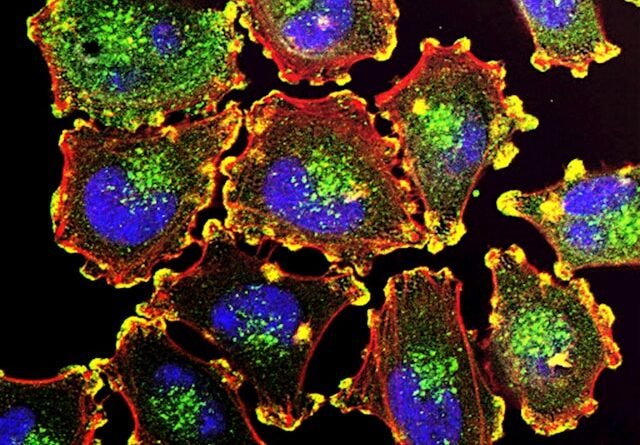
Take, for example, the recent intensive mapping of human U2OS cells—a line structurally tied to pediatric bone tumors. By constructing an interactive, high-fidelity atlas of these specific cells, researchers have already uncovered hundreds of previously unknown protein functions.
More importantly, the models have exposed exactly how minor genetic mutations cause specific protein assemblies to misfold or miscommunicate, effectively acting as a structural blueprint for how childhood cancers take root.
Instead of throwing broad, highly toxic chemotherapy treatments at a patient and hoping for the best, oncologists can now use these detailed maps to pinpoint the exact structural failure inside a malignant cell. It allows for the development of highly targeted therapeutics designed to disable a single rogue molecular machine while leaving the surrounding healthy tissue completely untouched.
Photo by National Cancer Institute on Unsplash
About Wellcore Weekly: Wellcore Weekly covers health, wellness, nutrition, sleep, fitness, and medical research with timely, easy-to-understand updates for everyday readers.