
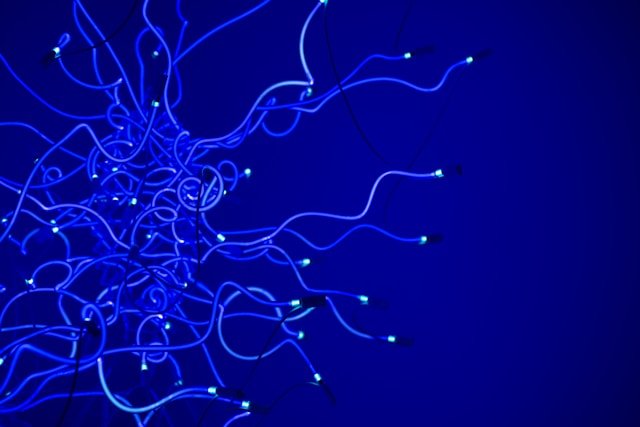
The Silicon Whisperers: Artificial Neurons Are Officially Talking to Your Brain
For decades, the “Brain-Machine Interface” has been a bit like trying to have a conversation with someone through a thick glass wall. We could send electrical pulses into the brain, and we could listen to the brain’s noise, but there was never a true, seamless dialogue.
According to a groundbreaking report in Nature Biomedical Engineering, researchers have developed artificial neurons that don’t just mimic brain cells—they actually converse with them. We aren’t just looking at a “device” anymore; we’re looking at a bridge between biology and technology that is starting to feel incredibly alive.
How the Conversation Works
Unlike traditional brain implants that act like rigid electrodes, these artificial neurons are engineered to be “bidirectional.” This means they can send signals to biological neural networks and—crucially—receive and process the feedback in real-time.
They don’t just fire off electricity; they adapt and respond. If the biological brain cells change their rhythm, the artificial neurons adjust to match. It’s a digital-to-biological handshake that feels like it belongs in the skull, rather than just sitting on top of it.
Why This is the “Holy Grail” for Recovery
The potential here for medical repair is staggering. We aren’t talking about “replacing” your personality; we’re talking about repairing the broken links.
- Paralysis: Imagine an artificial bridge that bypasses a spinal injury, allowing the brain to talk to the limbs again.
- Epilepsy: Neurons that can “sense” a seizure starting and send a counter-signal to stabilize the network before it spirals.
- Memory Loss: Engineered cells that could potentially act as a “backup drive” for damaged hippocampal circuits.
My Take: The Ethical Elephant in the Room
Here is where it gets spicy. If a machine can “talk” to your neurons in their native language, at what point does it start influencing how you think?
As we blur the line between our gray matter and silicon, we have to ask: who is in the driver’s seat? This technology is a miracle for someone who has lost the ability to speak or move, but it also brings us to the doorstep of a “Cyber-Biological” era that we aren’t socially or legally prepared for yet. When technology is this “alive,” the concept of privacy might need to extend to our very thoughts.
This is a “Moon Landing” moment for neuroscience. We have officially cracked the code on bidirectional communication with the human brain. The focus right now is rightfully on healing—but the implications for the future of human evolution are impossible to ignore. The barrier is gone; the conversation has started.
Photo by Chris Ried on Unsplash
About Wellcore Weekly: Wellcore Weekly covers health, wellness, nutrition, sleep, fitness, and medical research with timely, easy-to-understand updates for everyday readers.