
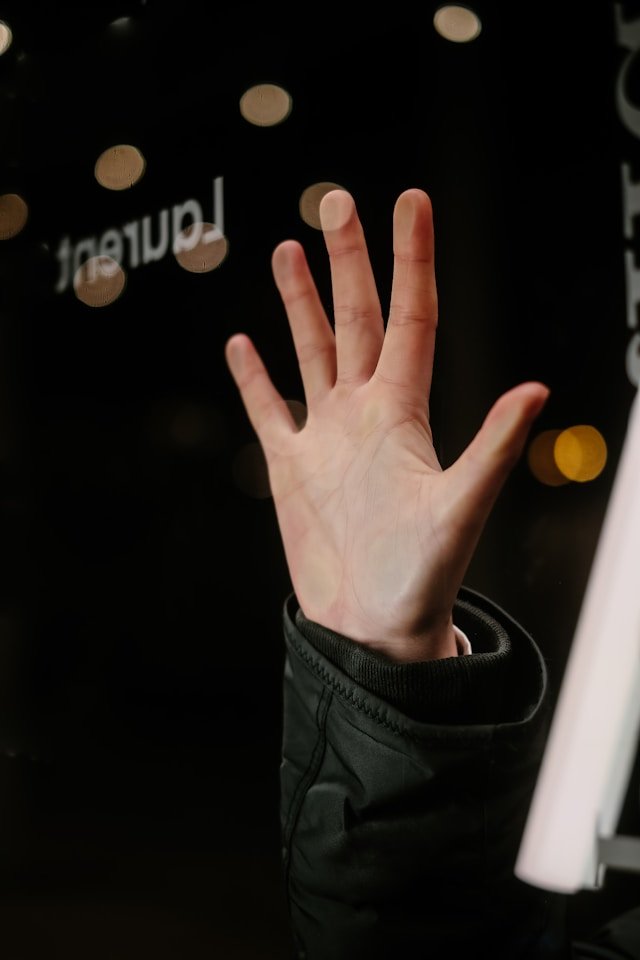
The reason you’re probably right-handed has been hiding in plain sight
A landmark study spanning 41 primate species suggests our dominant hand isn’t some genetic quirk — it’s a direct byproduct of the two things that made us human: walking upright and a rapidly expanding brain.
90% of humans prefer their right hand
41 primate species studied
2,000+ individual animals analysed
~55% right preference in chimpanzees
Think about it for a second. You probably already know which hand you use to write, which one instinctively reaches for a coffee cup, which one you’d use to catch something falling off a shelf. For roughly nine out of ten people on earth, that hand is the right one. It has always been this way — cave paintings from 40,000 years ago suggest the same split. And for just as long, scientists have been trying — and largely failing — to explain why the ratio is so extreme.
Other great apes show mild hand preferences, but nothing close to ours. Chimpanzees hover around 55% right, gorillas around 50. They’re essentially coin-flips. We’re not. Humans are a genuine statistical outlier in the primate family, and that outlier status has been the central puzzle in handedness research for decades.
Now, a major new study published in PLOS Biology offers what is — in this field, at least — a rare and satisfying near-complete answer. Researchers analysed handedness data across 41 primate species, covering more than 2,000 individual animals, and found that once they controlled for two specific variables, humans suddenly stopped looking anomalous at all. Those variables were bipedalism — walking upright — and brain size.
“Once you account for walking upright and relative brain size, humans stop being an evolutionary anomaly. They fit the primate pattern perfectly.”
HOW STANDING UP CHANGED EVERYTHING
The bipedalism link is, in retrospect, fairly intuitive. When our ancestors committed to walking on two legs somewhere between 4 and 7 million years ago, they freed their hands from locomotion entirely. Chimp hands still need to grip branches, support weight, and navigate terrain. Our hands, once upright movement was secure, became dedicated tools. And dedicated tools get specialised — meaning one side takes the lead.
What the study shows is that this pressure toward specialisation scales predictably. Species that spend more time upright — even partially — show stronger hand preferences than those that don’t. Humans, who are fully and permanently bipedal, show the strongest preference of all. The correlation is remarkably clean.
THEN THE BRAIN TOOK OVER
Bipedalism alone doesn’t get you to 90%, though. That’s where the second factor — brain expansion — becomes critical. As hominins evolved, the brain didn’t just grow larger. It grew asymmetric. Different hemispheres became responsible for increasingly distinct functions: language, planning, and fine motor control settled predominantly in the left hemisphere, which governs the right side of the body. The more lateralised the brain became, the stronger the hand preference.
This means handedness and language likely evolved together — two consequences of the same underlying shift in brain architecture. It also means we can roughly trace the intensification of right-handedness through the fossil record. Early hominins probably had hand preferences closer to 60-65% right — meaningful but modest. By the time Neanderthals were knapping flint tools and stringing beads, the evidence suggests preferences approaching our modern levels. Fully modern humans, with our larger and more asymmetric brains, landed at 90%.
AM Prof. Ananya Mehta, MD, FRCP
Consultant Neurologist — independent medical reviewer for this article
“What makes this study compelling is the methodological rigour — using comparative phylogenetic modelling across 41 species is substantially more robust than earlier single-species approaches. The bipedalism-lateralisation link has been hypothesised before, but this is the strongest quantitative evidence to date. Clinically, it reinforces what we see in stroke patients: damage to the left hemisphere disproportionately disrupts both language and right-hand function — the same functional cluster this study traces back to our evolutionary origins.”
THE 10% WHO DIDN’T FOLLOW THE SCRIPT
Here’s what the study cannot explain, and the authors are admirably candid about it: why has left-handedness persisted at all? If right-handedness was this powerfully selected for across hundreds of thousands of years, the 10% who remained left-handed should have vanished. They didn’t. They’re stable across cultures, across history, across every population ever surveyed.
The leading explanations aren’t fully satisfying. One involves frequency-dependent selection: in face-to-face competition, left-handed individuals have a documented surprise advantage — they’ve practiced against mostly right-handers, but their opponents haven’t practiced against them. This shows up clearly in sports like boxing, cricket, and tennis, where left-handers are statistically overrepresented at elite levels relative to their share of the general population.
Another theory points to genetic diversity and cognitive variation — that the same genes influencing left-handedness may confer advantages in certain cognitive domains, keeping them in the gene pool even if the hand preference itself is neutral or mildly disadvantageous. Neither explanation is proven. The honest answer is that we don’t fully know, and the persistence of the 10% remains one of the more interesting open questions in human biology.
STUDY LIMITATIONS — WHAT THIS RESEARCH CAN AND CANNOT TELL US
The study relies on behavioural observation for most non-human species, which may not perfectly capture neurological lateralisation. Fossil-based inferences about Neanderthal handedness carry inherent uncertainty. The model also cannot establish causation with certainty — bipedalism and brain size are correlated with handedness, but the exact developmental and genetic mechanisms that translate these evolutionary pressures into individual hand preference remain to be fully mapped. Future studies with neuroimaging data across species could strengthen these conclusions considerably.
WHAT THIS MEANS FOR YOU
This research is not, in itself, clinically actionable — it won’t change how a neurologist treats a patient or how a left-handed child is taught to write. But it matters in a broader sense. Understanding why human brains are lateralised the way they are sheds light on why brain injuries produce the specific deficits they do. The clustering of language and right-hand motor control in the left hemisphere isn’t arbitrary; it’s the product of a very long evolutionary story that this study helps clarify.
It also reframes left-handedness. For centuries it was treated as aberrant, corrected by force in schools, associated with superstition in dozens of cultures. This study suggests it’s better understood as the stable minority position in an ancient evolutionary equilibrium — not a defect, but a persistent variant that natural selection has repeatedly declined to eliminate.
The next time someone marvels at how uncanny it is that almost every human on earth favours the same hand, you can offer the least mystical and somehow most awe-inspiring explanation available: we all stood up, and then our brains grew enormously complex. Everything else followed from those two facts.
Editorial note: This article reports on published peer-reviewed research and is intended for general informational purposes only. It does not constitute medical advice. If you have questions about neurological health or conditions related to brain lateralisation, please consult a qualified healthcare professional.
PRIMARY SOURCE
Püschel, T. A., Hurwitz, R. M., & Venditti, C. (2026). Bipedalism and brain expansion explain human handedness. PLOS Biology. Published May 2026.
Dr. Priya Rajan, PhD
Neuroscience Editor, The Brain Brief
Dr. Rajan holds a doctorate in cognitive neuroscience from University College London and has spent 12 years reporting on brain science, evolutionary biology, and neurological research for both specialist and general audiences. She previously served as science correspondent at a national publication and peer-reviews for two academic journals in her field.
Photo by Philbo 🇺🇦 on Unsplash
About Wellcore Weekly: Wellcore Weekly covers health, wellness, nutrition, sleep, fitness, and medical research with timely, easy-to-understand updates for everyday readers.